White or black? Choosing a chef jacket colour

Most people choose between a white or black chef jacket in about four seconds, based on whatever the last kitchen they worked in wore. That is not a bad instinct. It is just not a decision.
Whites are traditional. Black hides more. Neither is automatically the right answer — it depends on where you are standing, who can see you, and how often you can realistically get a wash on.
This piece settles it: what each colour does across a service, what your house policy will say before you get a vote, and what an open pass changes. There is a comparison table below, and an honest ending.
What white does across a service
A white jacket shows everything. Oil off the pass, a thumb of demi-glace, the moment the blender lid did not seat. It shows it immediately, and it shows it from six metres away.
That is the point, not the flaw. Whites were never meant to hide dirt. They were meant to prove there was none. A clean white jacket at seven says the kitchen is on top of itself. A filthy one says the opposite, loudly enough that somebody deals with it.
White has a route back
The practical advantage is recovery. A white jacket comes back from a bad night in a way a black one cannot. You are not trying to match a dye. You are getting back to white, and a hot wash with the right stain treatment usually does it.
What actually kills a white jacket
Not the one bad stain. Most whites do not get ruined by a stain at all. They go grey slowly, from being washed the same way every week — cool cycle, mixed load, a bit of black trouser dye every time. Six months in, the jacket is not stained. It is tired, and you only notice how tired when a new one hangs beside it.
What black does across a service
Black buys you time. Sauce, stock, coffee and most oil disappear into it. On a double, or on a section you cannot step away from, that matters more than any argument about tradition. A black jacket that took a hit at half six is still presentable at ten.
It stretches further between washes, too. If you own two jackets and work five shifts, black is the colour that gets you through the week.
What black shows instead
Black does not hide everything. It shows flour like chalk. It shows lint off a tumble dryer, it shows dried salt, and under warm service lights it shows a grease sheen across the chest and forearms that white never registers. Black hides marks. It does not hide neglect, and on an open pass that difference is visible.
White or black chef jacket, side by side
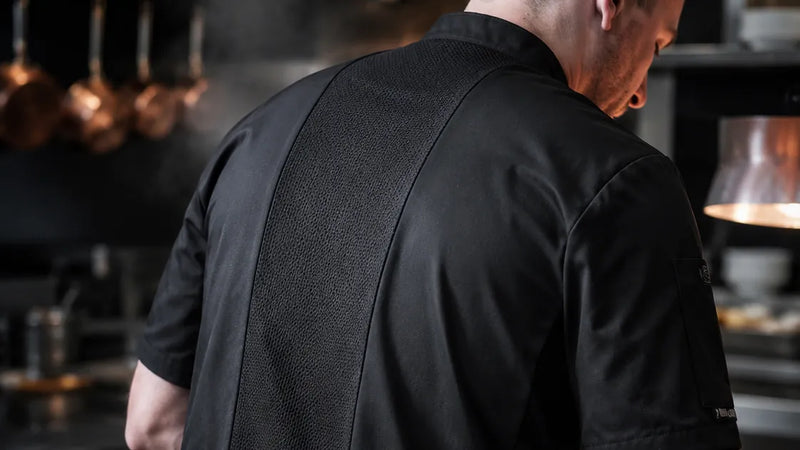
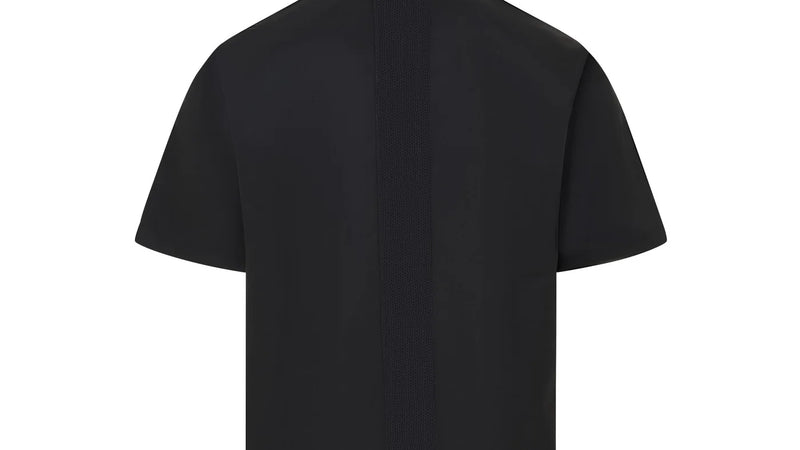
Same jacket in both cases, so the only variable is the cloth. Both are non-shrink poly cotton, double-breasted and short sleeve, with a mandarin collar, a sleeve pocket and a vented panel down the centre back.
| Consideration | White | Black |
|---|---|---|
| What a guest reads | Traditional, unmistakably kitchen | Modern, reads as staff, sits back in the room |
| What it hides | Nothing, deliberately | Sauce, stock, coffee, most oil |
| What it shows instead | Every splash, immediately | Flour, lint, dried salt, grease sheen under lights |
| How it looks late in a shift | Every mark shows | Reads cleaner for longer |
| After a bad stain | Can be brought back | Fades or patches rather than recovering |
| How it ages | Goes grey slowly | Goes flat and brown at the seams |
| Strict house uniform codes | The usual default | Accepted in some houses, banned in others |
| Price, Original | £14.99 | £15.99 |
Your house policy usually decides first
Most kitchens settle the white or black chef jacket question for you, and most policies say the same six things. Knowing them before your first shift saves an awkward conversation.
- Which colour, and whether it is the same for chefs and kitchen porters.
- Whether branding from another company is allowed on the chest.
- Whether short sleeves are permitted — some houses insist, some ban them.
- Who launders it, and whether an in-house service will take your own jacket.
- What you wear if guests can see the pass.
- Whether you arrive in it or change on site.
Branding is the line that catches people out. Another company's crest across the chest fails a strict uniform code even when the colour is right. That is why the same jacket comes in three tiers: the full embroidered crest, a small knife mark, and a Stealth version carrying no branding at all. If your head chef has opinions about logos, buy the quiet one and save the argument for something that matters.
An open pass changes the maths
If guests can see you, colour stops being a laundry question and becomes part of the room. A bright dining room with white linen usually wants whites — people have been trained on that image for a century. A dark, low-lit room usually wants black, because black sits back into the space instead of glowing under the spots.
Neither is a rule. Stand where the guest sits, in both, and look. That settles it faster than any argument in the kitchen.
Most chefs end up running both
This is the honest ending, and it is not a sales line. Once you have worked a few sections you stop picking a side. White for the days you are seen and can face the laundry. Black for doubles, prep, deliveries and the week you are already behind on washing. Two colours removes a decision rather than adding one, and the multi-buy takes 10% off two pieces, so the second jacket is not full price.
There is a middle option people forget. If the house wants whites and you cannot face washing one every night, a full-length black apron over the top takes most of what would have hit the jacket, and it costs less to replace.
Two cases where the balanced answer does not apply.
Buy black only
If you are a commis and you own two jackets, make them both black. You will not be on an open pass, and you will be given the jobs that ruin cloth. The wash you can realistically manage is one load on a Sunday. Whites are a commitment to laundry you do not have time for yet.
Buy white only
If you work pastry, or any section that lives in flour and icing sugar, buy white and stop reading. Black under a light dusting looks worse than white under jam, and it looks worse for the whole shift rather than for a minute. The same goes for any kitchen that has already written whites into the policy. The policy wins.
Common questions
Is a white or black chef jacket better for hiding stains?
Black, clearly. Sauce, stock, coffee and most oil vanish into black cloth, which is why it stretches further between washes. White hides nothing at all. The trade-off is that black shows flour, lint and a grease sheen under service lights, and it cannot be brought back once it dulls. White shows more, but it recovers better.
Do chefs still have to wear white?
In many kitchens, yes. Whites remain the default in classical and fine dining rooms, and plenty of houses write them into the uniform policy. Elsewhere black is now normal, particularly in casual dining, dark rooms and open kitchens. Ask before your first shift rather than guessing. It is a thirty-second question and it saves you buying the wrong colour twice.
Is a black chef jacket hotter to work in than a white one?
In a kitchen the heat comes off the pass and the ovens, not off the sun, so colour matters far less than airflow. What you feel is the weight of the cloth, the fit, and whether air can move through the jacket at all. A vented panel down the back and a short sleeve do more across a service than colour ever will.
How many chef jackets do you need?
Two is the minimum and it is tight. Three is the number that stops you doing laundry at midnight, because one is on, one is clean and one is in the machine. If you are running both colours, three usually breaks down as two black and one white, or the reverse if you regularly work a visible pass.
If you already know which way your kitchen leans, buy for that and get on with it. If you do not, start with black, add white when the laundry allows, and compare the two properly across the Vocal Chef vented chef jackets before you commit to a full set.