What a vented chef jacket actually does

A chef jacket is a sealed garment. That is mostly the point of it. Two layers of cloth across the chest, a collar that sits close to the neck, a front that stops splash reaching your skin. It protects you, and while it does that it also holds your own heat in.
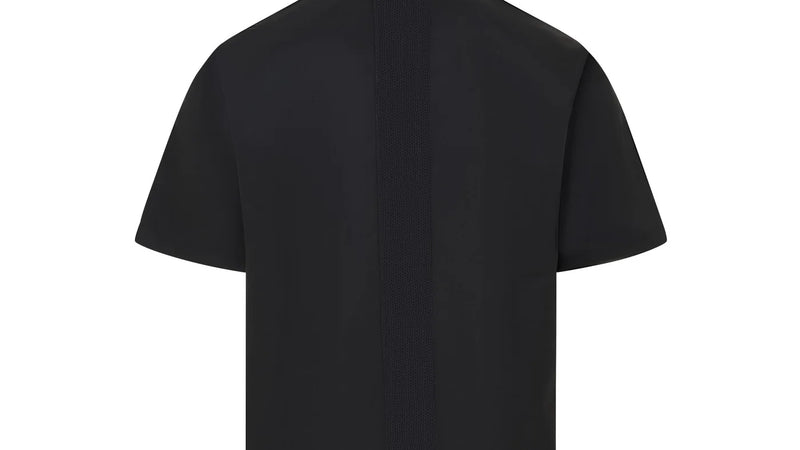
A vented chef jacket makes one deliberate opening in that seal, in the place where it costs you the least protection and buys you the most air. The panel runs down the centre of the back as a vented panel. Warm air leaves through it instead of sitting between your shirt and the cloth.
That is the whole claim, and it is smaller than most product copy makes it sound. This piece explains the physics plainly, then says what the panel does not do. A vent solves one problem and leaves the others where they were.
Heat pools across your back
Stand on a line for an hour and the warm air you generate does not stay where it is made. It rises. Inside a jacket it climbs the torso and collects across the shoulder blades, because that is where it runs out of room to go.
Two things make that worse. The first is that you are usually facing the heat, so the front of the jacket takes radiant heat off a stove while the back is still trying to shed yours. The second is that your back barely moves. Your arms pump a little air through the sleeves and armholes all shift. Your back sits flat against a still panel of cloth.
So the back is where heat gathers. It is also the safest place on the garment to open up. Nothing splashes there. Nothing you carry rests against it. It is the one panel that does not need to be a barrier.
What the vent actually is
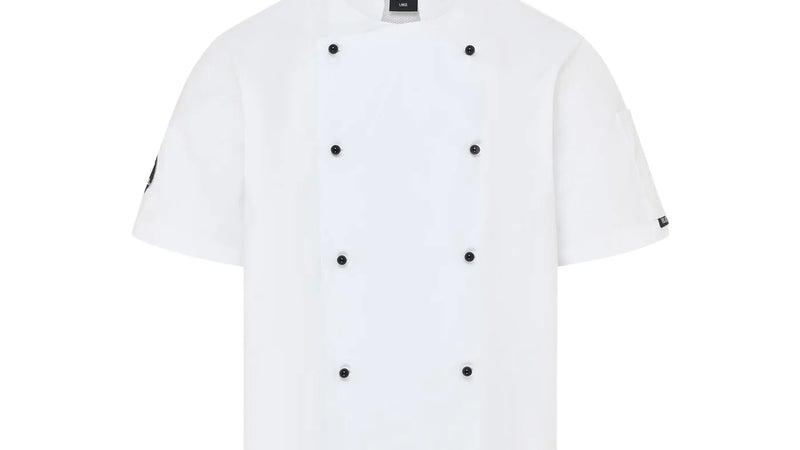
On our jackets the vent is a vented panel down the centre back. It is part of the garment rather than a slit or a flap. Everything else is the standard build: double-breasted, mandarin collar, black studded buttons, short sleeve, a sleeve pocket, non-shrink poly cotton throughout.
The effect is passive. There is no fan and no clever fibre doing something you cannot see. Warm air is less dense than cool air, so it moves up and out through whatever path is least resistant. If the only path is your collar, all of it has to travel past your neck to get away. If there is an open panel down your back, some of it leaves there instead.
The reason it matters more here than on a shirt is the front. A double-breasted jacket is two layers deep across your chest and stomach, buttoned shut, with a collar closing the top. It is the most sealed thing you wear at work. Cut a vent into a thin single-layer top and you barely register it. Cut one into that, and you are opening the only closed system you had on.
What a vented chef jacket does not do
This is the part that usually gets left out.
- It is not air conditioning. A vent moves air that already exists. If the air around you is hot, the air coming through the panel is hot too. It reduces the heat trapped against your skin. It does not lower the temperature of the room.
- It will not rescue a soaked shirt. Once your base layer is wet through, the cloth holds heat against you, and no panel will dry it mid-service. If you normally sweat through by nine, you will still sweat through by nine.
- It does not replace drinking water. Hydration does far more work than any garment you own. Treat the jacket as a small adjustment at the edge of a bigger problem.
- It does not make a hot jacket cool. You will still finish a busy Saturday warm. The realistic difference is at the margin: the shoulders feel less like a closed box, and less heat stacks up with nowhere to go.
- It does nothing below the waist. If your legs are the problem, the jacket is not the fix.
Vented back, mesh underarm, or lighter cloth
A vented chef jacket is not the only approach to this problem, and the other two are reasonable. They just make different trades.
| Approach | Where air moves | What you give up | Sensible for |
|---|---|---|---|
| Vented back panel | Centre back, the largest still area on the garment | Very little, since the back is not a splash zone | Hot lines, double-breasted fronts, long services |
| Mesh underarm panels | Armpit and upper side seam | Mesh sits where apron ties and bag straps rub, and the opening is small | People who notice sweat under the arms before the back |
| Lighter whole-cloth jacket | Evenly, everywhere, slowly | Thin cloth all over, including the front that faces the pan | Cooler kitchens, prep rooms, front of house |
Mesh underarm panels are not a bad idea. The underarm genuinely is where a lot of people notice sweat first. The catch is that the panel is small, it sits under strap pressure all shift, and mesh in a high-friction spot wears out first.
A lighter whole-cloth jacket is the simplest of the three, and in a cool kitchen it is probably the right one. You pay for it across the chest, where thin cloth is the only thing between you and a pan.
Where a vented back is the wrong choice
Cold sections and cold rooms
If you spend your shift in pastry, on larder, or in and out of a walk-in, an open panel across your back is a draught rather than a feature. You want the sealed jacket. Everything above assumes heat is your problem, and for plenty of people in a kitchen it is not.
If you need long sleeves
Some kitchens require a long sleeve for forearm cover, and some people want one regardless because of where they stand. Ours are short sleeve only. If your house rule says long, buy long, and do not let a vent talk you out of it.
If the problem is the uniform code
Wanting a jacket that passes a strict house code is a branding question rather than a ventilation one. The vented build is identical across all three tiers, so the Stealth jacket with no branding at all gets you the panel without the crest.
Common questions
Does a vented chef jacket actually keep you cooler?
It reduces trapped heat rather than lowering any temperature. Warm air rising off your back leaves through the open panel instead of collecting under the cloth. On a hot line, in a double-breasted jacket, you notice it across the shoulders. In a cool kitchen, or under a heavy overall that seals the back again, you will notice very little.
Can you wear a t-shirt under a vented chef jacket?
Yes, and most people do. Choose a thin one, and ideally one that is not solid across the back, because a heavy cotton tee simply reseals the gap you just opened. Our lightweight tee has its own vented back panel for that reason, and it works on its own for prep days.
Is a jacket with a vented back less protective?
Across the front, no. The double-breasted panel is unchanged, and that is the part facing the pan. The back is more open, so it is less of a barrier there. In practice almost nothing arrives at your centre back during service, which is why that panel was chosen for the vent rather than the chest or the sleeve.
Is a short sleeve chef jacket cooler than long sleeve?
Cooler, and less protected. Bare forearms shed heat quickly and air moves past an open cuff, which is why short sleeves are common on hot sections. The trade is real. A long sleeve covers your forearm against splash and oven edges. If that matters more to you than the heat, take the long sleeve.
The honest summary is that a vent is one small correction to a garment otherwise designed to hold heat in. It will not change your kitchen or your hydration. It changes one thing, on the one panel where it can be changed safely. If that is worth having, every jacket in our range of vented chef jackets carries the same panel down the back, in white or black.