What a kitchen uniform policy usually asks for

You get a start date and a one-line briefing. Whites, black trousers, safe shoes. That is usually all anyone says out loud. The actual kitchen uniform policy lives in a document you have not read, and you find out what is in it on your first shift, in front of people you met twenty minutes ago.
Most policies say the same six things. None of them are arbitrary. Each one traces back to hygiene, safety, or how the kitchen wants to look to a customer who can see the pass.
Here are the six, what each is actually for, and the one clause that is written more loosely than it reads.
The six things a kitchen uniform policy usually asks for
The wording changes from site to site. The substance rarely does.
| What the policy says | What it is actually for |
|---|---|
| No visible third-party branding | The venue's name should be the only one a guest can read |
| Closed, non-slip footwear | Spills, dropped knives, hot liquid, broken glass in a bin bag |
| Hair tied back and covered | Hygiene, and a complaint that gets written down |
| No jewellery beyond a plain band | Stones trap food and water; chains and watches catch on kit |
| Clean whites every shift | Cross-contamination, and being able to show you manage it |
| Who supplies and replaces the kit | Cost. This one is about money, not safety |
If you only get to ask one question before you start, ask about the last row. It is the one that comes out of your wages.
The branding clause catches more people than the rest combined
It usually reads something like this: no visible logos other than the employer's. Short sentence, wide reach. This is where a kitchen uniform policy stops being about hygiene and starts being about the venue's name.
Three reasons it exists. In an open kitchen the guest can see you, and the business would rather nothing competed with its own signage. A brand worn by staff can read as an endorsement nobody agreed to. And once one jacket carries a crest and another does not, a section stops looking like a team and starts looking like six people who happened to arrive at the same time.
Enforcement varies far more than the wording suggests. Some kitchens only care about what is visible from the dining room. Some check on the way in. Hotel groups and contract caterers tend to mean it, because the policy was written centrally for two hundred sites and nobody on your site has the authority to bend it. Independents often never mention it at all.
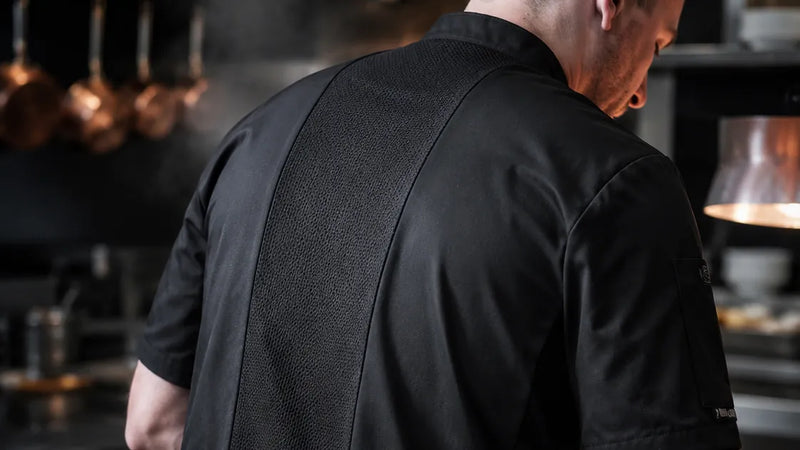
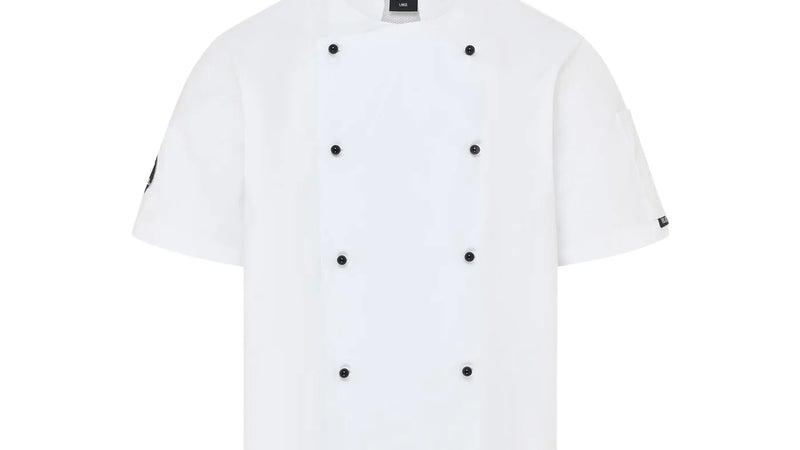
That clause is the reason our chef jackets come in three branding tiers. Original carries the full embroidered crest. Subtle carries only a small knife mark. Stealth carries no branding at all, so it clears a strict house code without a conversation. Same cut, same vented back panel, same black studded buttons. The only difference is what is on the outside.
Footwear, hair and jewellery come down to two risks
Something lands on you, or something of yours lands in the food. Every rule in this group is one of those two.
Closed footwear
Non-negotiable everywhere. You want closed uppers, a sole that grips a wet floor, and a fit that stays on when you move fast. Trainers with mesh panels read as open to most policies even though they look closed, and a mesh panel is exactly where hot oil goes.
Hair covered
A hair on a plate is a complaint, and a complaint gets recorded. Caps, skulls, nets or a tight tie-back under something, depending on the house. Beard nets appear in more policies than people expect. If the policy is quiet on headwear, ask rather than assume. Your own cap is either fine or a problem, and you cannot tell which from outside.
No jewellery beyond a plain band
A plain wedding band is the standard exception and usually the only one. Stones and settings hold food and water and do not come clean at a handwash sink. Chains, bracelets and watches catch on rails, oven handles and mixers. Some sites allow a single flat stud in the ear. Most do not, and none of them will make an exception on your first day.
Clean whites daily, and who pays for them
Clean daily
This is not only about looking tidy. A jacket that did yesterday's service is carrying yesterday's food, and that is a cross-contamination route an inspector will ask you about. Daily means a fresh jacket, not the same one aired on a hook overnight. Which quietly sets how many you need to own: enough to get through a week without depending on a mid-week wash.
Who pays
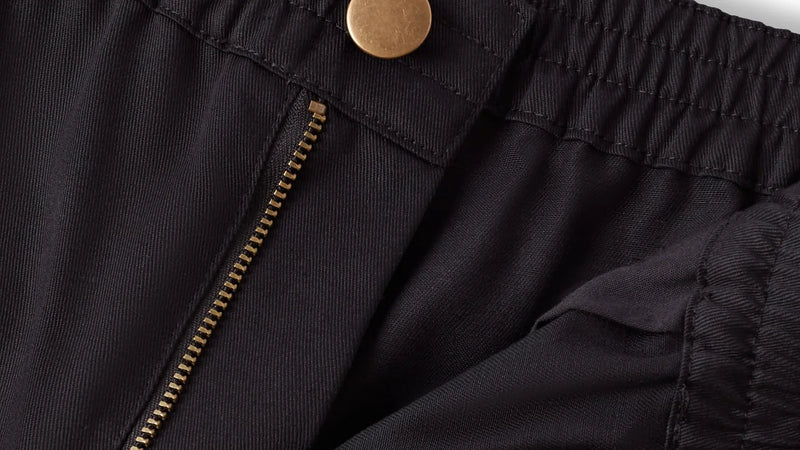
The most variable line in any kitchen uniform policy. Some kitchens issue whites and launder them on site. Some issue them against a deposit. Some pay for the first set and leave replacements to you. Plenty of independents expect you to arrive fully kitted and never raise it again. Aprons and hats are often supplied even where jackets are not, because they carry the venue's name. Black chef trousers and shoes are almost always yours. If nobody has told you, assume you are buying your own and be pleased if you are wrong.
Where an unbranded jacket is the wrong answer
We make a jacket with nothing on it, so it would be convenient to tell you everyone needs one. That is not true.
If your kitchen has no branding clause, or has one and does not enforce it, the crest is not a problem and plenty of people would rather wear it. Buying Stealth to solve a rule you do not have solves nothing.
If your employer supplies and launders whites, buy nothing until you have seen what they issue. Some house jackets are good. Spending your own money on top of a free uniform only makes sense once you know theirs runs hot, fits badly or comes back grey.
And if the choice is one unbranded jacket or three of anything, buy three. Getting through a week clean matters more than which mark is on the chest. A head chef will forgive a small knife mark long before they forgive yesterday's service on today's whites. If you are working out what to buy before a first shift, we have set out what to buy first and in what order.
Common questions
What do I wear to my first shift if nobody has told me?
A plain white double-breasted jacket, black trousers, closed non-slip shoes, hair tied back and covered, a plain band and no other jewellery. Bring an apron and a spare jacket in a bag. That clears almost every kitchen uniform policy in the country, and anything the house does differently they will tell you on day one.
Can I wear a chef jacket with another brand's logo on it?
Often yes, sometimes no, and the wording will not tell you which. Most policies ban visible third-party branding, but enforcement runs from strict to non-existent. Hotel groups and contract caterers usually mean it. Independents usually do not. If you want one jacket that is safe in either, choose one with no branding on the outside at all.
Do chefs have to buy their own whites?
It depends on the employer, and it is worth asking before you start rather than after. Larger sites often issue whites and launder them as part of the job. Independents frequently expect you to turn up with your own. Trousers and shoes are yours either way. Ask the head chef directly. Nobody has ever minded that question.
None of this replaces the one reliable move, which is asking your head chef what the house actually enforces before your first shift. Policies vary, and the written document is often not the same as the practice. If the answer comes back strict, or you would rather not have the conversation at all, an unbranded Stealth chef jacket takes the question off the table entirely.