Chef jacket buying guide: the six things that actually matter

Most chef jackets look the same on a product page. Two rows of buttons, a collar, a price. The differences only show up around hour six, when the jacket is either doing its job or getting in your way.
This chef jacket buying guide covers six things: fabric, sleeve length, closure, collar, pockets, and whether the branding will pass your kitchen uniform policy. Everything else on a listing is decoration.
Some of it is obvious once someone says it plainly. The rest hides behind words that sound like specifications and are not.
Fabric decides how the jacket ages
Poly cotton against pure cotton
Pure cotton breathes better and feels better on the first wear. It also creases, holds water, takes a long time to dry and shrinks. In a kitchen that washes uniform hot, that shrinkage is not theoretical. Sleeves ride up, the body gets shorter, and a jacket that fitted in March is tight by June.
Poly cotton gives up some of that first-wear comfort and gives you back shape. It dries faster, creases less and holds its measurements through repeated hot washes. Our jackets are non-shrink poly cotton for that reason.
What the copy hides
Watch for listings that say premium fabric, breathable weave or professional grade without ever naming a fibre content. Those are not specifications. If a seller will not tell you what the jacket is made from, assume the cheapest option and price it accordingly.
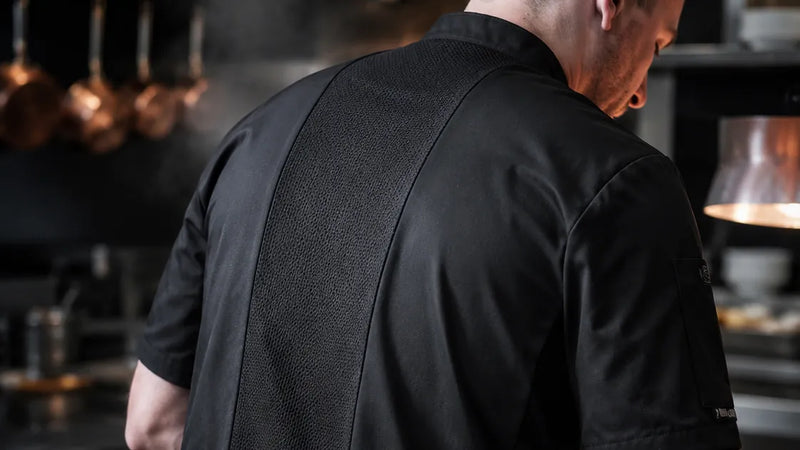
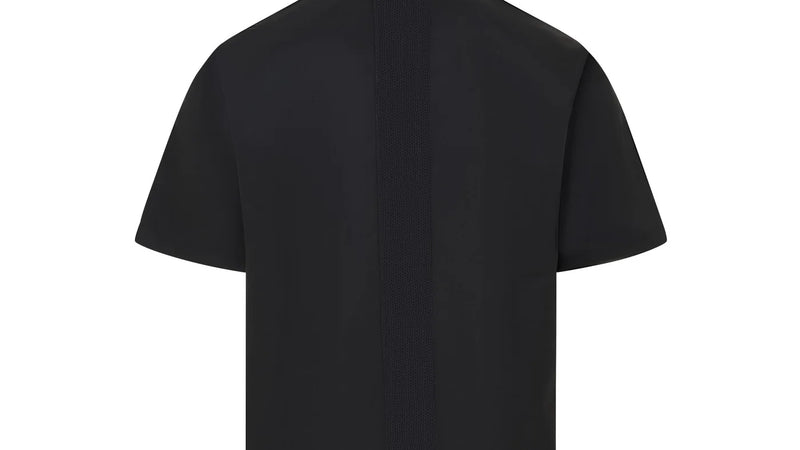
Be careful with breathability claimed by fabric alone. Airflow is structural as much as it is fibre. A vented panel down the centre back moves more heat than a slightly better weave does, because it puts the opening where your back is hottest and where nobody is looking.
Sleeve length is a heat decision before it is a style one
Long sleeves cover your forearms. That matters if you are reaching over open flame, pulling trays out of a deck oven or working a fryer. It is real protection, and some kitchens require it outright.
Long sleeves are also hotter, and cuffs get wet. A wet cuff against a hot pass is worse than a bare forearm. Short sleeves run cooler, dry faster and stay out of the sink. You give up the cover to get that.
We make short sleeve jackets. That is a position, not a universal answer. If you are on grill or fry, or your head chef expects sleeves down, buy long sleeves and ignore us on this one.
The closure, the collar and the pockets
Double-breasted, and why it reverses
Double-breasted is not styling. The two rows of buttons let you unfasten the front panel and do it up the other way, so a clean side faces out. Take a splash of jus down the chest at seven o'clock and you are presentable again in about fifteen seconds, without leaving the pass.
The second reason is the double layer of fabric across the chest. It sits between you and the splash and steam at the point where you lean over pans. Single-breasted jackets look neater and run cooler. They give up both of those things.
Check the buttons as well as the closure. Studded buttons come off and go back on, so they survive an industrial wash and can be replaced. Sewn buttons on a cheap jacket are usually the first thing to fail.
The mandarin collar
A mandarin collar stands up and stays where you put it. A folded collar flaps, collects grease along the fold and looks tired much faster. The standing collar also keeps steam off your neck when you lift a lid.
The trade is that it sits closer to your throat. Some people find that hot. If that is you, a folded collar is the honest choice.
Pockets you will actually use
Chest pockets are mostly theatre. Whatever you put in one sits against your sternum, gets warm, and falls out the moment you bend over a low oven.
A sleeve pocket works because it stays vertical. Thermometer, pen, tasting spoons: they sit on your upper arm, out of the way, and they are still there when you stand up. One pocket in the right place beats three in the wrong ones.
Branding is the rule that gets a jacket sent home
This is the part a chef jacket buying guide usually skips. Plenty of kitchens have a uniform policy that bans visible third-party logos, because the house wants its own name on the floor, or no name at all. A jacket you are not allowed to wear is not cheap at any price.
Ask before you buy. If the answer is no logos, you either buy plain or you buy from someone who makes plain. We built the range around that question. Original carries the full embroidered crest, Subtle carries only a small knife mark, and the Stealth jacket carries no branding at all, which is the one that passes a strict house code without a conversation.
The six factors of this chef jacket buying guide, side by side
| Factor | What to look for | What the copy hides |
|---|---|---|
| Fabric | A named fibre content, non-shrink if blended | Premium and breathable are not fibre contents |
| Sleeve length | Short for heat, long for cover, matched to your section | Long sleeves get sold as professional, never as hotter |
| Closure | Double-breasted that genuinely reverses, buttons that detach | Photos rarely show the second buttoning position |
| Collar | Mandarin if you want it tidy after fifty washes | Collar type gets styled, not explained |
| Pockets | A sleeve pocket you will use every shift | Pocket count is quoted, pocket position is not |
| Branding | A version quiet enough for your kitchen policy | Logo size is never stated in millimetres |
Where this guide stops being useful
If you cook at home, most of the above does not apply to you, and we would rather say so. You are not doing two hundred covers. Nobody is washing your whites hot twice a week. There is no uniform policy, so the branding tiers solve a problem you do not have.
At home an apron does most of the work a jacket does, for less money and less laundry. Buy the jacket if you want the reversing front and the sleeve pocket, or because you like wearing it. Those are fine reasons. They are just not the reasons in this chef jacket buying guide.
Common questions
Is a poly cotton chef jacket hotter than cotton?
Slightly, on the first wear. Pure cotton breathes a little better out of the bag. Poly cotton dries faster, so it stops holding sweat against you, and it keeps its shape through hot washes instead of shrinking. Ventilation matters more than fibre either way. A vented back panel changes how hot you get far more than the blend does.
What size chef jacket should I buy?
Ours come in small, medium and large. Leave yourself room to move, and remember a t-shirt underneath takes up some of it.
Will a chef jacket with a logo pass a kitchen uniform policy?
Often not. Many kitchens ban visible third-party branding on the floor, particularly hotels and restaurant groups with their own uniform. Ask your head chef before you spend anything. If the policy is strict, buy a jacket with no branding at all rather than hoping a small logo goes unnoticed on your first shift.
How much should a chef jacket cost?
Ours run from £14.99 for the white Original to £15.99 for black, Subtle and Stealth. UK delivery is free over £20 and a flat £2.99 below that, typically three to five working days with tracking. Two pieces take 10% off and three take 15%. The full terms sit on our delivery and returns page.
Work through the six in order and the decision usually makes itself: fabric, sleeves, closure, collar, pockets, branding. Once you know which of them you care about, our vented chef jackets are laid out by branding tier, so you can start from the rule your kitchen actually enforces.